Moshe Feldenkrais studied auto-suggestion and translated the book into Hebrew
published 1929 in ALE"F publishers
The injured knee
In 1929, Moshe Feldenkrais sustained a severe knee injury while playing soccer. This episode, often referred to in his biography, marked the beginning of a long process of recovery. During that time, he encountered the method of autosuggestion developed by Émile Coué (1857–1926), which appears to have played a decisive role in his rehabilitation.
What mattered was not only the technique itself but the shift of attitude it implied. Feldenkrais brought this orientation into his practice, to the point that he wished others to recognize and take in its meaning.
A distinctive how emerges here, shaping both the explorations in group lessons and the approach taken in Functional Integration: what to engage with, and what to refrain from. The orientation is toward pleasure, comfort, and ease—away from pain and strain. This includes, at a deep affective level, the willingness to meet what is present rather than what ought to be.
Exploration does not rely on force or willpower, nor on overstepping one’s limits. Instead, it turns to the form that emerges in exploration, lingering there. Visualization and imagination are guided by suggestive attitudes, which serve to steady thoughts and to quiet fear and anxiety.
From this perspective, the principles of do and do not in Feldenkrais’ work can be traced back, in part, to the influence of Autosuggestion.
האוטוסוגסטיה לפי שיטת אמיל קואה
The Practice of Autosuggestion by the Method of
Emile Coué by C Harry Brooks (1922)
Moshe Feldenkrais, a man of action with a dedication to sharing knowledge, translated The Practice of Autosuggestion by the Method of Emile Coué into Hebrew and added an epilogue. The book was published in 1929-30 by ALE’F publishers, which was managed by his brother, Baruch. He also added a two-chapter epilogue The Thought and the Deed.
The title was mistakenly translated to Thinking and Doing. Read the monograph to understand.
PARAGRAPH 3
The Hebrew Autosuggestion is published five times!
First edition 1929-30 (5690 תר״ץ),
second edition 1977,
third edition unknown,
fourth edition 1981,
fifth edition 1985. [1]
Notably, in 1977, after the San Francisco training, a new updated foreword was added by two professors of psychology from Tel Aviv University, Hans and Shulamit Kreitler. This is related to Moshe Feldenkrais's meeting with Milton Erickson.
This text was on the front page.
המדורה הראשונה של הספר שבידיך ראתה אור ב-1929.גואה עזר למאות אלפים לעזור לעצמם. גרסתו הוא שהדמיון יפה מן הרצון. דימוי הטוב והמוצלח עוזר יותר מכל מאמץ אחר.הפרופסורים קרייטלר החלוצים במחקר הפסוכולוגיה הקוגניטיבית חושבים הספר הזה חשוב כיום יותר משהיה
ת״א 1977 מ פלדנקרייז
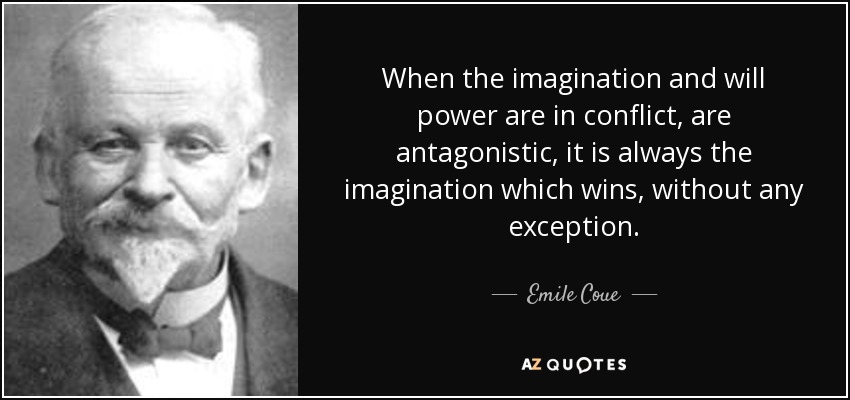
“The first edition of the book you hold in your hands was published in 1929. Coué helped hundreds of thousands to help themselves. His version was that imagination is superior to will. A good and successful image helps more than any other effort. Professors Kreitler, pioneers in cognitive psychology research, consider this book more important today than it was then.
Tel Aviv 1977
M. Feldenkrais”
Additionally, in 1981, the same year he published "The Elusive Obvious," a new Hebrew edition of Autosuggestion was released.
[1] My source is the library in Israel.
[2] https://en.wikipedia.org/wiki/Milton_H._Erickson
THE PRACTICE OF AUTOSUGGESTION BY THE METHOD of EMILE COUÉ
BY C. HARRY BROOKS WITH A FOREWORD BY EMILE COUÉ
The Thought and the Deed
is a more authentic and more appropriate name than Thinking and Doing, which became the title of the published monograph.
The Hebrew title has not been randomly chosen by Moshe Feldenkrais.
Read more fully and in detail in Article 6) why the title The Thought and the Deed is so informative about early traces of what was later to become... the Classical Feldenkrais Method
Three scientists writes two forewords, 48 years apart,
AutoSuggestion and the Epilogue follows MF throughout his life
How and when Moshe Feldenkrais encountered Autosuggestion is shrouded in obscurity, but maybe from a friend, Abraham Levanon who apparently got a signed photo from of Emilé Coué himself in 1921. This photo is copied into the first page of the published translation.
The Hebrew Autosuggestion of today has two forewords
In 1929 by Hugo S Bergman
in 1977, an additional foreword, by Professors Hans and Shulamit Kreitler was added.
Hugo S Bergman
Hugo S Bergman was invited by Moshe Feldenkrais to write an additional foreword about Coué and Autosuggestion. I leave it to you, the reader, to comprehend his life. What we do know is that he was a significant person in MF's life.
I have taken som information from the many links below.
BERGMAN, SAMUEL HUGO (1883–1974), philosopher. Bergman studied philosophy in Prague and Berlin. During his student days at Prague, he was a member and leader of the Zionist student circle, Bar Kochba, and in 1903 began to publish articles on Zionist and Judaic themes. From 1909, when Martin *Buber began to give his lectures on Judaism in Prague and other European cities, Bergman became his close disciple, although he sometimes was very critical of Buber, whose influence on him lasted throughout his entire life. ….
in 1920 emigrated to Palestine, where he became the first director of the Jewish National and Hebrew University Library in Jerusalem, a position he held until 1935. In 1928 he became a lecturer in philosophy at the Hebrew University, and in 1935 was promoted to professor…..
Bergman's main intellectual interests were scientific knowledge and religious experience. He saw reason and faith as two sources of truth and as grounds for human moral orientation, which endow life with significance. Throughout his entire life Bergman strove for a comprehensive approach to these two sources of truth, an approach which would resolve the mutual context of rationality and of mysticism, of knowledge of being with the human longing for sanctity and eternity….
https://www.jewishgen.org/AustriaCzech/hugo.html
https://www.jewishvirtuallibrary.org/samuel-hugo-bergman
https://www.forgottenbooks.com/en/readbook/FaithandReason_10012894#18
Hans Kreitler and Shulamit Kreitler
In the 1977 edition, Professors Hans Kreitler and Shulamit Kreitler of the Faculty of Psychology at Tel Aviv University. added a new preface discussing the role of Autosuggestion and Coué's important contribution.
They founded the department of psychology at the Tel Aviv University in 1961. They are known researches and writers in the psychology field (Psychology of the Arts.) MF adds in his handwriting on my copy how important he thinks that two cognitive psychologists like the Kreitler’ s are interested in Coué and that they suggest that Coué is as important in 1977 as in 1923. The Kreitler’s discuss science and AutoSuggestion and I can not but think that if they are invited to write a foreword when MF is republishing, then they reflect some ideas about how MF looked upon his own Method and science.
Hugo S Bergman refers to two persons, Charles Baudouin and Henri-Louise Bergson in his foreword about Coué in MF's translated book.
That they are mentioned I consider significant for the overall understanding of the epilogue.
HSB writes:
“…Charles Baudouin defined this psychological law as "the law of reversed effort." Any straining of the will that is in opposition to the imagined process will cause damage. This idea is in accord with Henri-Louis Bergson's philosophy, which states that willpower and intelligence are merely superficial expressions of the mind whereas their deeper manifestations are imagination and instinct.
As surface has no effect on depth, similarly, willpower will not alter the process of imagination. Therefore, our conscious will does not bring about actionable suggestions. Educating the imagination is more important than educating the will. Man fulfills in his life what his imagination directs him to do…”
C. Harry Brooks writes in his preface in the book that Moshe Feldenkrais later translated:
“…All readers who wish to obtain a deeper insight into the theoretical basis of autosuggestion are recommended to study Professor Baudouin's fascinating work, Suggestion and Autosuggestion. Although in these pages there are occasional divergences from Professor Baudouin's views, his book remains beyond question the authoritative statement on the subject; indeed, it is hardly possible without it to form an adequate idea of the scope of autosuggestion. My own indebtedness to it in writing this little volume is very great…”
Charles Baudouin is accessible with a newly republished book from 2017. It is also to be found in a pdf on line [1]. The chapter The Law of Reversed Effort widens the horizon for the perspective of Classical Feldenkrais. I recommend a read.
(Suggestion and Autosuggestion, A Psychological and Pedagogical Study Based Upon the Investigations Made by the New Nancy School)
Henri-Louise Bergson was and is an influential philosopher and Nobel prize laureate.
How he reasons around imagination and instinct, or intuition and instinct can be assimilated in many YouTube lectures. The expression the élan vital is contributed to him. And much more.
Bergman would not mention these two in the preface if it were not for the fact that Moshe Feldenkrais was well acquainted with their thoughts and ideas.
The beginning of Autosuggestion
“The traditional psychology was regarded by the layman, not without some cause, as a dull and seemingly useless classification of our conscious faculties. But within the past twenty-five years the science has undergone a great change. A revolution has taken place in it which seems likely to provoke a revolution equally profound in the wider limits of our common life. From a preoccupation with the conscious, it has turned to the Unconscious (or subconscious), to the vast area of mental activity which exists outside the circle of our awareness. In doing so it has grasped at the very roots of life itself, has groped down to the depths where the "life-force," the élan vital, touches our individual being. What this may entail in the future we can only dimly guess. Just as the discovery of America altered the balance of the Old World, shifting it westward to the shores of the Atlantic, so the discovery and investigation of the Unconscious seems destined to shift the balance of human life…”
“Not many people really understand me; apart from you there is only Professor Hugo Bergmann, head of the Philosophical Faculty at Jerusalem University, who is interested in the essence of this subject-matter and sees it as a rung on the evolutionary ladder of the human mind.”
Friedhelm Kemp wrote a review in 1969 about the book Improving the ability, which was translated into German under the title Walking Upright in 1969.
Moshe Feldenkrais wrote him a reply letter. It is published by IFF in a longer article. MF refers to Hugo S Bergman who helped him with the epilogue and wrote an important preface back in 1929-30. Forty years later, MF reports about their friendship in explicit terms.
Walking Upright: On Moshe Feldenkrais
Neue Zürcher Zeitung, January 19, 1969
........................................................
Letter (originally in French) by Moshe Feldenkrais to Friedhelm Kemp
Tel-Aviv, January 28, 1969